Vanitas paintings, popular in 16th- and 17th-century Europe, use objects to remind viewers of the fleeting nature of life, the inevitability of death, and the limits of earthly pleasures. Each carefully chosen element carries a symbolic message, encouraging reflection on mortality, morality, and what truly matters. Here’s a closer look at some of the most common symbols and what they mean.
Skulls
Skulls are the most iconic vanitas symbol, appearing in almost every composition. They offer a stark reminder that death comes for everyone, regardless of status, wealth, or beauty. Their presence interrupts the illusion of permanence, inviting viewers to consider life’s brevity and the ultimate futility of chasing worldly success.
Vanitas Still Life. Pieter Claesz. 1630.
Books
Books represent human knowledge, learning, and intellectual achievement. In vanitas paintings, however, they also point to life’s limitations. No amount of wisdom or study can prevent death, and even intellectual pursuits are temporary. Their inclusion encourages reflection on the value of knowledge alongside spiritual and moral awareness.
Still Life with Books. Jan Lievens. 1630.
Candles
Candles symbolize the passage of time and the fragility of life. A burning candle reflects the present moment, while a snuffed or melting candle signals mortality. The gradual depletion of wax mirrors the fleeting nature of existence, reminding viewers to cherish life while it lasts.
Vanitas. Van der Meulen. 1668.
Flowers
Flowers are vibrant symbols of beauty, vitality, and the pleasures of life. Yet their blooms are short-lived, and petals inevitably wilt and fall. This natural cycle underscores the impermanence of all living things, reminding us that even the most alluring aspects of life are temporary.
Vanitas Still Life with Bouquet and Skull. Adriaen van Utrecht. 1642
Hourglass
The hourglass is a simple but powerful emblem of time passing. As sand steadily slips from one chamber to another, it makes mortality visible and tangible. It serves as a reminder that life is finite, every moment matters, and no one can escape the steady march toward death.
A Vanitas Still Life with a Skull atop a Book, an Hourglass, and Two Glass Vases of Flowers. Guercino. 1619-1620.
Jewelry
Jewelry represents wealth, luxury, and social status. In vanitas paintings, it emphasizes the appeal of material possessions while also warning that such objects are temporary. No amount of gold or gems can stop time or prevent mortality, encouraging viewers to focus on values beyond material gain.
Vanitas Still Life with a Sunflower and Jewelry Box by Maria van Oosterwijck. 1675.
Musical Instruments
Musical instruments symbolize pleasure, creativity, and the enjoyment of life’s moments. Yet music itself is fleeting—the notes fade as soon as they are played. Instruments in vanitas paintings highlight the transience of enjoyment, suggesting that sensory pleasures, like life, are temporary.
Still Life with Musical Instruments. Pieter Claesz. 1623.
Fruit
Fruit represents abundance, vitality, and life’s sweetness. Over time, fruit spoils and decays, reminding viewers that even the most enjoyable aspects of life are temporary. Its inclusion underscores the passage of time and the inevitability of decline.
Still Life of Fruit and Dead Fowl. Harmen Steenwijck. 1650.
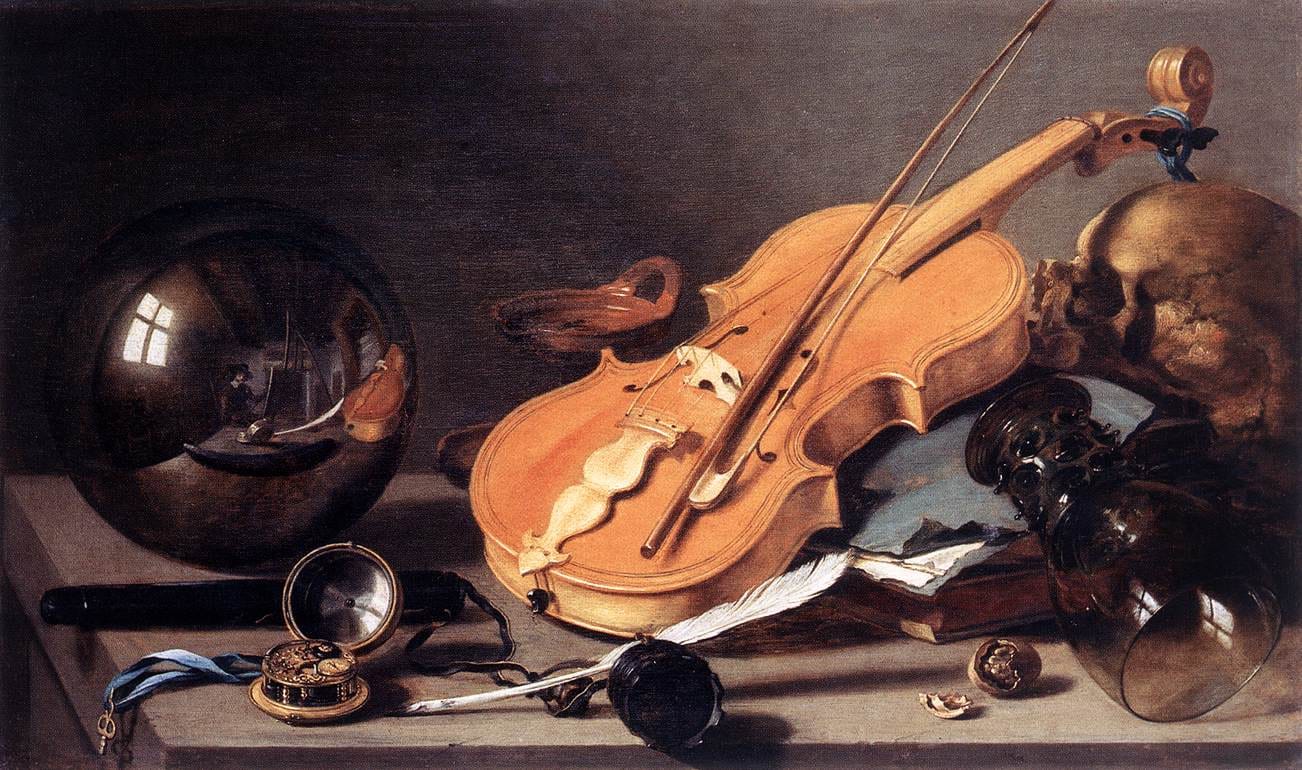
Mirror
Mirrors reflect beauty, self-awareness, and, at times, vanity. In vanitas imagery, they caution against being overly focused on appearances. A mirror’s reflection is fleeting and deceptive, symbolizing that outward beauty fades and the inner life is what endures.
Vanitas with Violin and Glass Ball. Pieter Claesz. 1628.
Smoking Items
Pipes, cigars, or extinguished incense symbolize fleeting pleasures and the passage of time. Just like smoke, enjoyment rises and disappears quickly. These items remind viewers that indulgences, while tempting, are temporary and cannot prevent the inevitability of mortality.
Vanitas with Bouquet of Flowers and Pipe. Jan Davidsz de Heem. 1685.
Glass or Drink Vessels
Glass objects, such as goblets or wine cups, highlight fragility and delicacy. Their beauty can be destroyed in an instant, serving as a visual metaphor for the fragility of life and the temporary nature of indulgence. They invite contemplation on both pleasure and mortality.
Vanitas Still Life. Peter van Kessel. 1668.
Clocks and Pocket Watches
Timepieces make the passage of time explicit. Clocks and pocket watches underscore that life is finite and constantly moving forward, whether we notice it or not. They encourage mindfulness and reflection on how we spend our limited days, reinforcing vanitas’ central message that time is precious.
Still Life with a Skull, a Gold Pocket Watch, an Hour Glass, a Globe, Musical Instruments, Candlestick, a Gold Tazza and an Open Book on a Partially Draped Table. Franciscus Gijsbrechts. 1675.
Bubbles
Bubbles in vanitas paintings are a delicate but striking symbol of life’s fragility and sudden impermanence. They appear bright and perfect for a moment, then vanish without warning, making them a simple but powerful reminder that beauty, pleasure, and time all disappear faster than we expect.
Vanitas Still Life with Soap Bubbles by Joannes de Cordua (Attr.). 1650-1702.
Conclusion
Vanitas paintings use these symbols to communicate a timeless message: life is fleeting, death is certain, and worldly pleasures and accomplishments are temporary. Each object—from the skull to the candle, the flower to the clock—invites reflection on mortality and encourages viewers to consider what truly matters. By engaging with these reminders, vanitas art challenges us to appreciate the present, seek deeper meaning, and focus on values that endure beyond life’s impermanent pleasures.
Get ready to uncover the hidden meanings behind six renowned paintings! We’re going to delve into the enigmatic layers of these masterpieces, revealing insights that may have eluded your initial gaze. Prepare to appreciate these artworks in a fresh light as we unveil the hidden meanings you may have overlooked!
The Hidden Last Supper in Van Gogh’s Café Terrace at Night
There are a ton of theories about the hidden meanings in DaVinci’s The Last Supper painting, but did you know there’s a hidden last supper in a Van Gogh painting?
Van Gogh’s Café Terrace at Night isn’t just a charming street scene; it also has some hidden symbolism. Some see a resemblance to The Last Supper in the arrangement of the figures. There’s a central figure in the café who could be seen as Jesus, surrounded by others in a similar layout to the famous painting. This adds a fascinating layer of religious symbolism to the piece.
Vincent Van Gogh. Cafe Terrance at Night. 1888.
The way Van Gogh used light in the painting enhances this symbolism. The brightly lit café, glowing warmly against the dark night sky, creates a sense of intimacy and gathering. This contrast between light and dark can be seen as a metaphor for the warmth of community versus the isolation of the outside world. Van Gogh often explored themes of loneliness and connection, and this painting subtly reflects those personal struggles.
So next time you check out Café Terrace at Night, think about how van Gogh might have been hinting at deeper themes of spirituality and human connection, even in a casual café setting. It’s like uncovering a hidden message in a beautiful work of art, making the painting even more intriguing and meaningful.
The Hidden Brain in the Sistine Ceiling
Michelangelo’s Creation of Adam on the Sistine Chapel ceiling is famous for that iconic moment where God reaches out to touch Adam’s finger. But here’s a cool twist: some people think there’s a hidden brain in the painting! If you look closely at the shape surrounding God and the angels, it looks a lot like a human brain. The flowing red cloth and the positioning of the figures mimic the brain’s anatomy, with God and the angels fitting into what would be the different sections of the brain.
Michelangelo. Creation of Adam. 1508-1512.
This hidden brain might be Michelangelo’s way of showing the divine spark of intelligence and consciousness that God gave to humans. Michelangelo was not only an incredible artist but also studied anatomy in great depth. By sneaking in this brain image, he could be suggesting that our intellect and wisdom are divine gifts, making the painting even more layered and thought-provoking.
This isn’t the only hidden gem that Michelangelo snuck in there. In another panel there’s a cheeky little detail you might not notice at first glance: one of the cherubs is “flipping the fig.”
Michelangelo. Prophet Zechariah. 1508-1512.
This old-school hand gesture, where you stick your thumb between your index and middle finger, was basically the Renaissance equivalent of flipping someone off. It’s a playful and somewhat rebellious touch from Michelangelo, showing that even in his grand religious artworks, he had a sense of humor and wasn’t afraid to sneak in a bit of mischief. What other hidden meanings can be found in the Sistine Ceiling?
The Reflection in Van Eyck’s ArnolfiniPortrait
One of the most intriguing parts in the Arnolfini Portrait by Jan van Eyck is the reflection in the convex mirror hanging on the wall. If you zoom in, you’ll see a tiny reflection of the scene unfolding behind the artist. It’s like a Renaissance selfie with a twist! Scholars have debated what exactly the mirror is showing. Some say it’s a reflection of witnesses to the marriage, while others argue it’s a subtle nod to van Eyck’s skill as an artist, showcasing his ability to capture intricate details.
Jan Van Eyck. Arnolfini Portrait. 1434.
Take a closer look at the mirror and you might spot another hidden tidbit: van Eyck’s signature. He was so proud of his work that he signed it right there, tucked away in the intricate details of the chandelier’s frame. This signature adds another layer of meaning, emphasizing van Eyck’s role as the mastermind behind this masterpiece.
Jan Van Eyck. Mirror Detail. 1434.
Now, let’s talk symbolism. Mirrors in Renaissance art were often associated with themes of vanity and self-awareness. The inclusion of the mirror in the Arnolfini Portrait could be a clever commentary on the couple’s social status or their self-image. It’s like van Eyck is inviting us to ponder the complexities of identity and perception, all while marveling at his technical prowess.
Adding another layer to the intrigue of the Arnolfini Portrait is the fact that it was likely completed after the death of Arnolfini’s wife. Giovanni di Nicolao Arnolfini’s wife, Giovanna Cenami, passed away not long after their marriage. Some art historians speculate that the painting was commissioned to commemorate their union or as a memorial to Giovanna after her death. This adds a poignant dimension to the artwork, suggesting that what we see captured in the painting is not just a moment frozen in time, but also a testament to love and loss.
The Hidden Meanings in Vermeer’s The Music Lesson
Johannes Vermeer’s The Music Lesson isn’t just a snapshot of a music lesson. Take a closer look, and you’ll notice something interesting: the woman’s reflection in the mirror isn’t quite matching up with what she’s looking at. While she appears to be focused on her harpsichord in the main scene, her reflection seems to be gazing off in a different direction. It’s like she’s lost in thought or contemplating something beyond the room. Some believe she’s looking at her tutor, suggesting a connection between the two. This subtle detail adds a whole new layer of mystery to the painting, making you wonder what’s really on her mind.
Johannes Vermeer. The Music Lesson. 1662-1665.
And let’s talk take a closer look at that mirror—it reveals so much more! In classic Vermeer style, every little detail has a meaning. The mirror reflects not only the figures but also a hidden doorway and window, hinting at spaces beyond the viewer’s sight. It’s almost like Vermeer is inviting us to peek into another world, sparking our curiosity and imagination. Plus, mirrors in art often symbolize self-reflection and introspection, so the woman’s gaze being directed differently in the mirror might be a clever nod to the idea of inner contemplation.
From the delicate patterns on the rug to the way the light dances on the instruments, every inch of the painting is packed with meaning. The soft, diffused light creates a cozy atmosphere, drawing you into the scene and making you feel like you’re right there in the room. The careful composition and rich details invite endless interpretation, making The Music Lesson a timeless masterpiece that captivates viewers.
The Butt Music in Bosch’s Garden of Earthly Delights
Hieronymus Bosch’s Garden of Earthly Delights is a wild ride from start to finish, and there’s one detail that’s sure to make you do a double-take: the music score on the man’s butt! Yup, you read that right. In the center panel of the triptych, amidst all the chaos and debauchery, there’s a dude chilling out with a music sheet painted right on his behind. Talk about cheeky art!
Hieronymus Bosch. Garden of Earthly Delights. 1490-1510.
Bosch was known for his surreal and symbolic imagery, and the music score is no exception. Some art buffs think it might represent the idea of earthly pleasures or indulgence in sensual delights, which fits right in with the overall theme of the painting. Others speculate that it could symbolize the discordant and chaotic nature of worldly pursuits, contrasting with the harmony of celestial realms.
Hieronymus Bosch. Butt Music. 1490-1510.
But here’s the kicker: no one really knows for sure what Bosch was trying to say with that music score on the guy’s butt. Garden of Earthly Delights is like a visual puzzle just waiting to be solved, and every wild little detail invites speculation and interpretation.
Believe it or not, the story gets even crazier! In 2015, a music student named Amelia Hamrick noticed the music score hidden on the man’s butt while studying Garden of Earthly Delights. Intrigued by this bizarre detail, she decided to transcribe the notes and turn them into real music. With a bit of creative interpretation and a lot of patience, she managed to bring the cryptic score to life. The result? A hauntingly beautiful piece of music that captures the enigmatic essence of Bosch’s masterpiece.
Hamrick’s discovery and subsequent musical interpretation add yet another layer of intrigue to the painting, showcasing how art can inspire creativity centuries after its inception. Others have shared their own interpretations of the butt score on YouTube, offering a rabbit hole that rapidly plunges into the surreal.
The Hidden Message in Munch’s The Scream
While Edvard Munch never explicitly stated what the painting symbolizes, many interpretations of The Scream suggest it reflects the anxiety and turmoil of the modern human experience. The figure’s distorted features and the chaotic background convey a sense of existential dread and alienation that resonates with viewers on a visceral level. It’s like Munch is tapping into the universal fear of the unknown and the fragility of human existence.
Edvard Munch. The Scream. 1893.
The painting’s composition and color choices also add to its emotional impact. The stark contrast between the bright, swirling sky and the dark, eerie figures creates a sense of tension and unease. Some art historians even suggest that the red sky in the background may symbolize the eruption of Krakatoa in 1883, which blanketed the sky with fiery hues and contributed to a sense of impending doom in Munch’s time.
But Munch didn’t just slap a screaming guy on a canvas and call it a day—he added a little inscription in the upper left corner that says “Can only have been painted by a madman.” But what does it mean?
Edvard Munch. The Scream Inscription. 1893.
Some art historians believe that the inscription reflects Munch’s own struggles with mental health and the intense emotions that inspired his work. Others see it as a commentary on the turbulent state of the modern world, where chaos and uncertainty reign. Regardless of its interpretation, the “madman inscription” invites viewers to ponder the hidden meanings behind The Scream and the deeper layers of emotion embedded within.
As we unravel the mysteries of Munch’s masterpiece, we’re reminded that art is more than just brushstrokes on canvas—it’s a window into the human soul. The “madman inscription” serves as a poignant reminder of the artist’s inner turmoil and the universal experiences of fear, anxiety, and despair. It’s a testament to the power of art to evoke raw emotions and provoke thought, leaving an indelible mark on those who gaze upon it.
Thanks for reading! Don’t forget to check out these great posts too!
Happy Friday the 13th! Whether you think it’s unlucky or not, we got a Friday the 13th in October this year and that makes my favorite month even more special! To celebrate, I picked out 13 dark and creepy paintings. From explorations of the taboo to dealing with trauma, these artists created masterpieces that will send chills up your spine!
Saturn Devouring His Son – Francisco Goya
You’ve probably seen this one before. No? Search for dark, creepy paintings and Saturn Devouring His Son will be one of the first to pop up.
Toward the end of his life, Goya moved into a villa outside Madrid. He painted its walls with a series of works known as his “Black Paintings”. None of the paintings were named by Goya and they were not intended to be viewed by the public. It wasn’t until after the paintings were removed from the walls and transferred to canvas that they were named for their subjects.
Francisco Goya. Saturn Devouring His Son. 1819 – 1823.
Saturn was painted in the dining room, and depicts the Roman god Saturn eating one of his children after being told that one of them would overthrow him. The deity appears consumed by madness while he tears into his victim. It’s been interpreted as a representation of time consuming all things, the inescapability of God’s wrath, and the conflict of old age and youth. Some scholars question whether this is a depiction of Saturn at all, since the usual references to this story are absent.
This famously dark and gory painting made by a man in his twilight years, with its limited palette and loose composition, masterfully captures a moment of an insatiable hunger driven by fear.
The Nightmare – Henry Fuseli
I remember seeing this one in college, but not much else. Either we didn’t spend much time on The Nightmare or I wasn’t paying attention… Still, it’s an image that stays with you. What is that creature sitting on that poor lady and why is he looking at us? Whose nightmare is this anyway? And what’s up with that horse?
Henry Fuseli. The Nightmare. 1781.
The creature is an incubus – “a type of spirit said to lie atop people in their sleep or even to have sexual intercourse with sleeping women.” The title of the painting suggests it may also reference a “mare”, a mythological being known to suffocate or torture people in their sleep. The woman’s pose and vulnerability coupled with the presence of the incubus add a layer of sexuality to the painting that was considered scandalous at the time, yet the piece was popular enough that Fuseli painted other versions.
But what about that horse? It wasn’t in the drawings Fuseli did before the actual painting. It’s not a pun on the title, but may reference some other elements of folklore. Other interpretations say the horse peeking through the curtains confirms the sexual nature of the woman’s nightmare – on full display for the viewer.
You can’t have a list of weird art without Dali being on it. His work takes you places that you wouldn’t find on your own and in some cases make you wonder if you really want to be there. The Face of War depicts a face contorted in fear, reflected again and again within itself. Snake slither around the outside and a single handprint (Dali’s) marks the lower right corner.
Salvador Dali. The Face of War. 1941.
The Face of War was painted during the brief time Dali lived in California. He fled to the United States at the start of WWII after the Germans took France. This happened just after he spent 1936-1939 in Paris to escape the Spanish Civil War. War deeply impacted his life and it’s no surprise he chose to depict the horrors and trauma caused by it.
Girl with Death Mask (She Plays Alone) – Frida Kahlo
I had teachers throwing Kahlo lessons around from Junior High through college and not once did this painting come up. It’s like they just want to teach The Broken Column and move on. Girl with Death Mask is believed to be a self-portrait of Kahlo at age four. The mask is similar to those worn in celebration of the Day of the Dead and the flower she holds is likely an offering for a grave.
Frida Kahlo. Girl with Death Mask (She Plays Alone). 1938.
The girls stands in a desolate landscape, perhaps suggesting that in the end we all die alone. Her youth stands in contrast with the theme of death – something we prefer to associate with old age. Whether or not the painting is autobiographical is up for debate, but Kahlo was no stranger to pain and ill-health and death is a theme she often played with.
The Severed Heads – Theodore Gericault
Most figure painters worked from live models, or at least used them as references. So what did an artist use to paint severed heads? And why? In Gericault’s case, he used actual severed heads. He also painted other body parts and corpses, but it wasn’t a macabre series that led him to paint them. The Severed Heads is one of several painting studies in preparation for a larger piece.
Theodore Gericault. The Severed Heads. 1818.
At the Paris Salon in 1819, Gericault presented the gasp-inducing Raft of the Medusa, which depicted aftermath of a shipwreck. This included the survivors and detailed renderings of the casualties. So even though there are no mythological connections are or symbolic meanings to his studies of body parts and corpses, the fact that they are meant to directly represent a real human tragedy adds a layer of real-life horror.
Death and the Miser – Hieronymous Bosch
You may know The Garden of Earthly Delights, but did you know about this one? Bosch’s art overall was pretty out there, perhaps making him a surrealist ahead of his time. The Garden of Earthly Delights was a triptych (a three-panel painting) and Death and the Miser was part of one too.
Hieronymous Bosch. Death and the Miser. ca. 1490.
This painting is a deathbed scene, where the miser is tempted with gold by a demon under his bed and an angel implores him not to give in – all while death waits at the door. Themes of good and evil pervade the composition and allude to the corrupt life the miser led.
The Ghost of a Flea – William Blake
Can you imagine every insect that dies leaves a ghost behind? Do you need a soul to become a ghost after you die? Does that mean fleas have souls?? Luckily that’s not what The Ghost of a Flea is about.
William Blake. The Ghost of a Flea. ca. 1819.
There’s a lot going on in this little (8.42″x6.3″) painting, which is based on a vision that Blake had at a seance in 1819. The flea, a grotesque humanoid figure, is a symbol of greed and filth. He carries a bowl of blood in his left hand and a thorn in his right, framed by curtains and stars. The monstrous form is dark, evil – and according to what it told Blake it is the manifestation of bloodthirsty men.
Big Electric Chair – Andy Warhol
What is Andy Warhol doing on this list?? His work was colorful and bold! What’s creepy about soup cans? Big Electric Chair is actually part of a series by Warhol where he juxtaposed bright colors over the dark imagery of the chair.
Andy Warhol Big Electric Chair. 1967.
The image itself is a cropped press photograph of the electric chair at Sing Sing prison, which had been used for the last time in 1963. The series as a whole calls out the exploitation of tragedy in the media while it “emphasizes the pathos of the empty chair waiting for its next victim.”
The Flaying of Marsyas – Titian
Titian is a big name in Renaissance art, but this isn’t one of the paintings they usually teach. In Greek mythology there was a satyr named Marsyas who challenged the god Apollo to a musical contest. The Flaying of Marsyas depicts the scene after the satyr lost.
Titian. The Flaying of Marsyas. ca. 1570.
As Apollo skins Marsyas alive, a cute little dog laps up his blood and another satyr brings a bucket into the gruesome scene. The scene is one of agony, suffering, and the delight of those who inflict it.
Skull of a Skeleton with Burning Cigarette – Vincent Van Gogh
This isn’t what typically comes to mind when you think of Van Gogh, but as an artist he went to some dark places – both in life and in paint. Skull of a Skeleton with Burning Cigarette is actually one of his earlier works and was painted as a joke while he was attending classes at the Royal Academy of Fine Arts in Antwerp.
Vincent Van Gogh. Skull of a Skeleton with Burning Cigarette. 1886.
It was common practice for students to study the human skeleton to learn about anatomy and proportion, but Van Gogh wanted to express vibrance and life with his art. Adding the cigarette to the skeleton was his tongue-in-cheek way of giving a little life to his study.
Dante and Virgil – William-Adolphe Bouguereau
Before we get into this painting, can we just stop to appreciate the expression on the demon in the background? He’s just having his own moment back there. If there’s a character anywhere in this blog that needs a caption, it’s this demon. (Note to self: spend a whole post writing stuff for this background demon!)
Bourguereau was not known for painting dark compositions like Dante and Virgil. He was trying to win an art competition, so he chose a scene from Dante’s Divine Comedy, which happened to be a favorite topic of one the judges (he still didn’t win).
William-Adolphe Bouguereau. Dante and Virgil. 1850.
In this scene, Dante and Virgil watch a brutal fight between two damned souls. The trickster Gianni Schicci savagely bites into the neck of the heretic Capocchio as other souls suffer the tortures of Hell in the background. However, what eclipses all of the pain and agony of this scene is that fact that no one talks about that demon.
Death of Marat – Jacques-Louis David
Here’s another big one from college! Jean-Paul Marat was a French revolutionary leader and friend of the artist. Marat was assassinated in his home by a political enemy, leading David to capture the event in his painting, Death of Marat.
Jacques-Louis David. Death of Marat. 1793.
Marat suffered from a skin condition that left him spending much of his time in the bathtub – so much that he often worked there. The assassin gained entrance to Marat’s home with a note promising useful information. Once inside, she stabbed him. Thus we see Marat, bleeding in the tub with a note in his hand and the murder weapon on the floor.
Screaming Pope – Francis Bacon
We’ve talked about Francis Bacon before and this is the same one – the artist, not the philosopher. While this painting is often referred to as the Screaming Pope, the title is Study after Velázquez’s Portrait of Pope Innocent X. Generally Bacon didn’t paint from life and didn’t take commissions, which freed him from any obligation or consideration of painting a “respected” figure in a favorable light. This is probably why he chose Velasquez’s Pope paintings to base his own on – even for a commission Velasquez favored realism over flattery.
Francis Bacon. Screaming Pope. 1953.
Bacon was so taken with Velasquez’s pope paintings, that he painted his own series for over 20 years. He claimed it was the only place he could use this color palette. All of his popes are boxed in, screaming or close to it. Some critics believed the series was Bacon’s way of dealing with issues with his father, which the artist brushed off. Bacon said the popes were rather his way of surpassing Velasquez.
With only 13 paintings for Friday the 13th we obviously couldn’t get to all the wonderfully dark paintings out there. So tell me, which ones did I miss? What are your favorites? Let me know in the comments!
We’re going back to school – high school that is. The art room was my sanctuary in those days. My art teacher was such a huge influence on so many kids and she was the main reason I ever thought I was any good at art.
With art classes came art history lessons. As a teenager I loathed any sort of history-related learning, so I thought it would be fun to take a trip down memory lane and see what stuck! Here are four artists I remember studying and what I remember learning about them.
Georgia O’Keeffe
She was, and still is, one of my favorite artists. O’Keeffe was referenced a lot in the art room and my art teacher even kind of looked like her. We painted the obligatory close up of flowers in one class and in another class we painted buildings in her Precisionist style.
She was beautiful in every photo Stieglitz took of her
My art teacher lived on a farm and brought in stuff for us to draw. There was a cow skull we often sketched, Chinese Lanterns, and so many eggplants. Seriously. So. Many. Eggplants. I don’t eat them, don’t like looking at them, please don’t ever let me have to draw an eggplant again… Still, it all takes me right back to school days.
O’Keeffe was a woman of many layers. This biography is an excellent look at her life and offers a perspective on her work through her eyes.
Picasso
Is there a kid that took art classes that didn’t have to do a Cubism project? Most of what we learned about Picasso left my brain long ago, but I do know we didn’t learn about the double entendre in his work or that he was an infamous womanizer. It’s extra funny to me since we spent a fair amount of time studying The Dream.
The Dream. 1932.
Most of what we focused on was cubism (we had to paint a study of Guernica at one point), but “The Old Guitarist” is what struck a chord with me. Picasso’s Blue Period has always been my favorite because of the raw emotion it exudes.
The Old Guitarist. 1903.
Salvador Dali
If I go digging I might still have the pastel recreation I did of The Persistence of Memory (the melted watches). I also did a huuuuuuge study of Sleep, which didn’t need to be so huge except I made the thing longer than it was supposed to be and just went with it.
Sleep. 1937.
I don’t remember learning much about Dali himself in art class, but we did learn a bit about him in Spanish class. I drew an entire scene of aliens and ninja turtles (which I still have) on the article we had to read about Dali in Spanish. He was muy prolifico! The article talked a bit about how eccentric he was, but didn’t really mention his sexual predilections. As 10th graders we probably didn’t need to know that he was a butt man.
Dali was pretty kooky (and kinky) to say the least. I recommend his book 50 Secrets of Magic Craftsmanship if you want a peek into his process. Take it all with a grain of salt and enjoy the ride!
Max Ernst
The first surrealist I learned about wasn’t actually Dali. It was Ernst. This one might be more from elementary school, but there is one word that is permanently in my brain from our lessons about Max Ernst: decalcomania.
First you lay some paint down, then you push something into it to create texture. Then you use that texture as part of your composition. It leaves some of the process up to chance and I don’t recall having much luck (or patience) with it as I smooshed tin foil and crumpled paper into my paint. Ernst, on the other hand, often used the technique to create his Surrealist landscapes. I still love his work. Maybe it’s time to try decalcomania again…
The Eye of Silence. 1943-44.
Back to School Bonus! The Dadaists
DA DA DA DA DA DA DA DA DA DA DA DA DA DA DA DA!!
That’s how this video starts and transitions through this hour-long documentary about the Dada art movement. It’s so burned into my brain that it’s all I can remember from the video. I don’t know if we had a substitute teacher that day or if the video was planned, but it gets your attention even if you aren’t paying attention. We only watched it for that one class – I think. Something about it makes me feel like I saw it more than once.
And now, I pass the experience on to you! DADADADADADADADADADADADADADADADA!
Romare Bearden was born on September 2, 1911 to (Richard) Howard and Bessye Bearden in Charlotte, North Carolina. In 1914, they moved north to Harlem, New York, joining millions of other African Americans in the Great Migration, looking for greater racial equality and more financial and educational opportunities. They lived there as the Harlem Renaissance ushered in a rebirth of African American culture and the arts.
Howard was a city sanitation inspector. He was also known to be quite the story teller and was a talented pianist. Bessye became a social and political activist and became the NY correspondent for the Chicago Defender, a regional African-American newspaper. She also became the first president of the Negro Women’s Democratic Association.
Music and Stories
The Beardens were a well-educated family and friends with some of the most prominent figures in Harlem at that time. They knew poet and writer Countee Cullen and musician Duke Ellington. They were also friends with actor, activist, and athlete Paul Robeson, founder-president of the National Council of Negro Women Mary McLeod Bethune, and the first African-American surgical intern at Harlem Hospital Dr. Aubré de Lambert Maynard. This gave young Romare exposure to some of the creative and intellectual minds of his time.
Duke Ellington
Countee Cullen
Mary McLeod Bethune
Paul Robeson
Aubre De Lambert Maynard
Romare spent his summers with his grandmother in Pittsburgh, Pennsylvania. She ran a boarding house for steel mill workers, many of whom were African American migrants from the South. The stories he heard them tell later became themes in some of his collages.
In the 1920s, the Beardens moved to Pittsburgh. When Romare graduated high school there, art wasn’t his passion yet. Instead he went to college for science and math. While in college, he played semi-pro baseball for the Boston Tigers in the Negro Leagues.
Education
Romare’s higher education began at Lincoln University in Pennsylvania, where he studied science and math. His interest in art sparked when he discovered cartooning while attending Lincoln and soon aspired to be a cartoonist.
After a year he transferred to Boston University, where he was the director of the college humor magazine. While in Boston he took courses with artist George Grosz at the Arts Students League. Grosz was an asylum-seeker from Germany, whose art sharply criticized what he saw the decline of German society. Although he turned to painting more traditional themes in the United States, his influence helped Romare explore his own ways of depicting his experience as an African American through his art.
Under Grosz’s tutelage Romare studied the Old Masters and explored Cubism, Futurism, Post-Impressionism, and Surrealism. During this time he also exhibited some of his early work at the Harlem YMCA and the Harlem Art Workshop.
A couple of years later, Romare transferred to New York University where he began to focus more on art. He became the lead cartoonist and editor for the student magazine and graduated in 1935. He continued to study under George Grosz for another two years, supporting himself as a political cartoonist for African American publications.
The Exploration of Experience
Romare Bearden Army Photo
Romare Bearden began as a painter, depicting religious themes in oil and watercolor. His first solo exhibition was in Harlem in 1940, but had to put his art career on hold in 1942 when he was drafted into the US Army. He served in World War II in the 372nd Infantry Regiment, a racially segregated unit, until 1945 when he was honorably discharged.
Factory Workers. Romare Bearden. 1942
That same year he showed his series, The Passion of Christ, at the Samuel M. Kootz Gallery in New York City. The reception of his work was overwhelmingly positive. One of the images from that series, He is Arisen, was purchased by the Museum of Modern Art (MoMA). It was his first piece that was purchased by a museum and also his first piece put into a museum collection.
He is Arisen. Romare Bearden. MoMA. 1945.
By 1950 Romare began to feel disillusioned and alienated by the systemic racism of American society. Using funds from the GI Bill, he to travelled to Paris and lived there for a couple of years. Romare met and befriended prominent creatives and intellectuals of the time, including Pablo Picasso and Jean-Paul Sartre. He also became a central figure in the black expat community in Paris. During that time he travelled Europe, studying art, literature, Buddhism, and philosophy. He explored techniques like Chinese painting and developed his collage process. It was around this time that his work also became more abstract, partly due to the influence of Picasso’s Cubist work.
When Romare returned the United States, he worked for the New York City Department of Social Services as a case worker. On nights and weekends, he continued to paint, developing his technique when he had the time.
How Abstract is Abstract Enough?
In the 1950s, Romare was dropped by the Samuel M. Kootz gallery because his art wasn’t keeping with the trends of the time – it simply wasn’t abstract or modern enough by their standards.
A Walk in Paradise Gardens. Romare Bearden. 1955
In 1954 Romare got a studio above the Apollo Theater. His style became more abstract and showed influences of his study of Chinese painting techniques. That same year he married dancer and choreographer Nanette Rohan.
He later relocated the studio to downtown New York, but Harlem was still very much a part of his work and central to his life. Romare was a case worker by day and an artist on the side until 1969 when was was able to fully support himself and Nanette with his art. He was able to open his own studio, started earning grants, and had time to work on commissions.
Through the Pages
Romare Bearden’s rise as an artist began in the 1940s, but it was in the 1960s when he was really seen as a master collage artist. That was when he started focusing primarily on his collage work. He had been struggling with “expressing his experiences as a Black man and the obscurity of abstract painting.”
The collages were made from cutting of popular magazines like Time (some of his work made the cover of magazines he tore pages from), African American magazines like Ebony and Jet, colored paper, and texture techniques with paint, graphite, and sandpaper. His work echoed the means of African American slave crafts, such as patchwork quilts, where they had to work with whatever materials were available to them. As one article describes his art, “Bearden crafted the African American experience in his works.”
In the early 1960s Romare joined the Cordier & Ekstrom Gallery, where his work was exhibited for the rest of his life. He also showed his work through the United States and sometimes in Europe.
In 1963 he created the Projections series, comprised of collage and photomontage techniques, photojournalism, and Pop Art. He depicted scenes of Pittsburgh and Harlem, but mostly Charlotte, North Carolina.
The Baptism. Romare Bearden. 1964
By the late 1960s Romare was a popular visiting professor at various universities. He also joined other artists to form the Cinque Gallery of New York. This was in direct protest to the 1969 exhibition Harlem on my Mind put on by the Metropolitan Museum of Art. The show did not allow black artists to exhibit and so Cinque was created to allow only black artists.
In 1973, Romare and Nanette made a second home in the Caribbean (St. Martin) where her ancestors were from. While there, he studied the culture and influence of Africans brought over through slave trade; themes that became apart of his work. His art also became more musical during this time, “from the urban blues of Kansas City and Harlem nightclubs, to the blues and church music of Mecklenburg, North Carolina.”
Of the Blues Carolina Shout. Romare Bearden. 1974
Romare Could Do Anything
Romare was a man of many talents. Although collage had become his primary medium, he continued to paint murals and series pieces for exhibitions. He “completed more than a dozen mural commissions in a variety of media including collage, ceramic tile, and faceted glass”.
He illustrated posters, wrote and illustrated books, and was a successful lyricist. Romare wrote songs for Billie Holiday and Dizzy Gillespie. He also helped out Nanette, occasionally designing programs, costumes, and sets for Alvin Ailey American Dance Company.
Social Activism and Legacy
Throughout his career, no matter what he was working on, Romare made sure to give back. Whether it was commentary in his art, opening a gallery as a form of protest, or creating an organization to help minority emerging artists – Romare wanted to give his community as much opportunity as possible to succeed. These are just some of his accomplishments and awards:
Romare Bearden died of bone cancer on March 12, 1988 in New York City. His ashes were scattered in St. Martin “as the French West Indies had been the subject of later works.” They never had kids, but Romare left a lasting legacy as both an activist and a creator.
Conclusion
There are a few things I need to address here. First, how the heck do you say his name?? I remember studying Romare Bearden back in high school (it’s been a minute) and we learned it as ro-MARE, two syllables, emphasis on the second syllable. According to his friend Albert Murray, it was actually pronounced RO-muh-re, three syllables, emphasis on the first. Murray also said Romare was named after a neighbor his mother liked.
The second thing is that there is far more information here than I can provide. Please explore the resources linked here. There are so many resources and so much to learn about Romare and the world he grew up in.
Finally, I don’t feel I did Romare Bearden’s work the justice it deserves with this article. I want to leave a couple of quotes here from my sources that have the words I didn’t seem to this month.
“One of Bearden’s works that best captures this amalgam of styles is titled The Block. It depicts a Harlem street, with row-house buildings and the bustling life of the neighborhood. At first glance, it’s a cacophony of shapes and images. But as the scene settles in, the faces of people catch the eye. Composed of two or more fragments of photos, they begin to reveal a lifetime of experiences.”
The Block. Romare Bearden. 1971
“His works’ complexity lies in their poetic abstraction, in which layered fragments of colour and pattern evoke the rhythms, textures, and mysteries of a people’s experience”
Thank you for reading! Don’t forget to check out our other Artists of the Month!
Romare Beardon was an artist that could do anything. He drew cartoons, painted, collaged, designed costumes, wrote songs, and authored books. Beardon used his art to challenge the idea that black artists should only create art rooted in their own culture. He explored ways to depict the daily lives of African Americans in the rural south and urban north through modern art; all while expressing the changing landscape of civil rights and social norms.
Romare Beardon had a prolific career and led an impactful life. We’re going to have a lot to talk about!
Sorry for the cringy title. I put it down as a placeholder figuring I’d come up with something better by the time I got done writing this. You know what else was hard? Coming up with a project for Kjartan Slettemark! He was edgy and political. As much as I admire his work, political is not something I do here. I want my community to be a safe place to chat, to be silly, to talk about a good/bad/boring/exciting day without any judgement.
On top of that, Kjartan loved his plastic and how do you digitize that? Looking back at Nixon Visions, I could have taken his image and processed it in a bunch of different ways, but in the end it was something else that spoke to me. The Poodle costume.
I love everything about this thing. The best part is that it all came about because of a typo. Six months of work to prove a point against system that dogged the man for years over his mental health all because they couldn’t spell. So good!
Then I came across this image:
That’s when I knew I needed to paint a sexy KjARTan poodle and that’s exactly what happened. One layer, black and white, done in one sitting.
It was so much fun to paint! A little dark, a little weird – it’s the kind of art I love to make. So there you have it, my little homage to Kjartan Slettemark!
The first thing I noticed when researching the life of Kjartan Slettemark is that there aren’t many sources to reference. He was such an interesting artist – how can this be?? We’ll dive as deep as we can in this post, but it’s worth checking out the sources and seeing what else there is. If there’s one thing authors can agree on, it’s that Kjartan lived and breathed his art!
Kjartan’s Early Life
Born in August 6, 1932 in Naustdal, Norway, Kjartan Slettemark was the youngest of four siblings. He pursued a formal arts education, eventually teaching for a time, but he found that Academia didn’t suit him and moved to Sweden in the mid-1960s.
Playing with Plastic
The 1960s marked the rise of plastic. As a material in the daily life of the average person it replaced more expensive materials. For the art world, it was a new medium to explore. In 1964, Kjartan took a course on in plastics engineering. He made many pieces from plastic, including a cake, eggs, and masks. He even cast his own form in plastic and was wrapped in plastic wrap.
Tool for a Hero, Vacuum-packed Collage. 1991.
One of his most famous (and controversial) pieces was a collage made from plastic that protested the Vietnam war.
VIETNAM
In 1965 Norway, Kjartan burst into public view with plastic, politics, and controversy. As part of a project titled “Image of the City”, he created a plastic collage. The composition was an open mouth – inside were the letters VIETNAM, a tiny American flag, and a small figure representing an injured child. With it he included the text, “From a report from Vietnam: Children are showered with burning napalm, their skin is burned into black wounds and they die.” The work was based on a newspaper report that detailed how children were burned to death with napalm.
On Reports from Vietnam, 1965.
The collage was put on display (along with other artists’ works) in front of the Storting, the Parliament of Norway, in Oslo. It was vandalized at least three times by different people, but it wasn’t taken down. The art remained in its display case for the rest of the show with police protection to prevent further vandalism.
More importantly, the attention garnered by the Vietnam collage got people talking about US involvement in the war and debating art as a platform for protest. Some authors highlight how intense the public reaction was to the piece, but it did was good art does – it started the discussion and brought out peoples’ raw feelings. The Vietnam war was already controversial and polarizing. The art gave the public a target for their stance on the issue and a platform to express how they felt.
On Sweden and Being “Borderline”
Kjartan became a Swedish citizen in 1966 after living in Stockholm for 6 years. He was an art teacher for a while, but was fired for refusing to give the students grades (he gave them colorful drawings instead!). As a result, he had to file for social services in 1964. Four years later, he showed up at a social services meeting in an “eccentric outfit” with red and green caps on his teeth. The agency questioned whether Slettemark was simply unemployed or mentally ill. He told them he was an artist that was diagnosed as “borderline” and was prescribed anti-psychotic medication. They tried to commit him, but he refused.
Kjartan’s battles with social services over his mental health was a situation he often explored in his art. He dove into what it meant to be “borderline” and what it meant to be “somewhere between healthy and sick, normal and deviant.”
In 1969, Kjartan put his medication and other items on display in an art show that showcased his mental health struggles. He printed the invitations for the show on welfare application forms. But what truly made this a Kjartan event was that he sent the bill for whole show to social services.
News coverage of the show brought enough public attention to finally bring the situation with social services to an end.
The Passport
Kjartan was staunchly opposed to Richard Nixon and the war on Vietnam. However, after Nixon resigned, Kjartan claimed to feel some sort of connection to him. Kjartan just happened to need to renew his passport, so he took an image of Nixon taken from a 1971 campaign poster and put his own hair and beard on Nixon’s face. He capitalized is name as KjARTan to “sign” the art and submitted it with his passport renewal. The application was processed without incident. He used the passport to travel Europe and to and from the United States several times and was never stopped.
Nixon Visions
Around the same time as the passport, “Nixon Visions” was born from the same Nixon campaign image. Kjartan turned the image into a coffee advertisement and processed the image over and over again throughout the years. One version shows blood running from Nixon’s mouth and cup while another depicts him with a Hitler mustache. Some iterations deconstruct the image, such as one where the eyes are cut out in triangles, switched, and flipped upside down. Another removes the face completely and replace the coffee cup with pieces of the face.
Performance ART
In 1976, Kjartan created his infamous poodle costume. He had once again been summoned by social services, but they mistakenly told him to report to hundmottagningen, which translates to “dog reception”, instead of kundmottagningen, “customer reception”. He spent six months creating the costume, which included built in jackpot sounds and a fluffy codpiece.
At one point Kjartan made passports for his own country of Kjartanistan, producing about 500 of them for anyone that wanted to be a citizen. It was a “non-territorial state with planet Earth as capital city, and himself as prime minister.”
In 2003, he donned a Marilyn Monroe wig and created a Warhol-style collage series titled “Self-Portrait with Marilyn”. He had to give a speech after receiving an award from the Academy of Fine Arts in Stockholm and asked if he could wear the wig, to which they said “Of course!”
Conclusion
This is just a small capture of Kjartan Slettemark’s work. The Poodle was only one of many costumes he wore to blur the lines between life, art, and public discourse. Later in his career he explored his view of the world through video. Nixon Visions continued well into the 2000s. Kjartan was an active artist to the end, stirring the pot until he died on December 13, 2008 of heart failure.
I wasn’t kidding when I said information about KjARTan was sparse. There are some sources that provide additional details about his life, but I don’t include information that I can’t cross-reference with something else. My sources always have more than what I include in my posts, so please give them a click if you want to learn more. And don’t forget about the other artists we’ve covered this year! Thank you for reading!
Technique is something we haven’t talked about enough for Artist of the Month. Lucky for us, Peter Paul Rubens is a *fabulous* master to study when it comes to materials and application in painting! The man was able to finish a masterpiece in a matter of hours thanks to the media and techniques he used. So how did he do it?
Influence of a Master
Rubens was heavily influenced by Titian, a talented and prolific Italian painter from the 16th century (that’s really an understatement). The two artists just missed each other by a couple of decades, as Titian died in 1576, the year before Rubens was born. Still, Rubens was able to enjoy Titian’s work in travels to Italy and copied the master’s work well into his own career. In total he painted 21 Titians!
Venus of Urbino. Titian. 1538.
Although Rubens studied the master in depth, they worked in different ways. Titian started with a complete composition painted in grayscale called a grisaille as an underpainting. Then he would add color and depth with transparent glazes. Rubens wanted to create the same effect, but with an all prima technique. This literally means “at first attempt” and refers to wet in wet painting. Think Bob Ross painting happy little trees and making sure every bush had a friend – that’s alla prima.
Tools of the Trade
There are few things Rubens did to speed up his process. First, he almost always started with a finished drawing. This meant he didn’t have to worry about the composition while he painted – he was able to focus completely on his technique.
The next key to his craft was the medium he used in his paint. Described as a “thick jelly”, it consisted of 10 parts each linseed oil, turpentine, and mastic tears, and one part litharge (or powdered white lead pigment or white lead paste). Talking about the properties of these materials is for another post (let me know if you want to jump down the rabbit hole!), but this medium gave Rubens the ability to apply both transparent and translucent layers while retaining the texture of the brushstroke. It gave him the flexibility to scumble in colors or blend them seamlessly.
The medium was also a bit of a double-edged sword. It would start to dry after a few hours, making it unworkable. So Rubens was able to work a piece quickly, but it was partly because he had to.
Can the Technique Be Digitized?
For our project this month I decided to follow the same steps Rubens did to make a painting. Since Rubens’ first step was to start with a finished drawing, I grabbed a sketch I did from some unknown length of time ago and created a color palette based on colors he actually used (more on that next post).
These are some of the colors Rubens used.
The Base
He would start on a light umber background, so I took the umber and lightened up about halfway for my base. Next he would sketch his composition on top of that with a wash of darker brown, using it to map out the shadows and line the lighter areas. I copy pasta’d my sketch onto my base, locked the pixels, and colored it in with Van Dyck brown. It’s a little cheatsy, but I figured it was about the same thing.
The problem with this is that the sketch was done with a pencil brush, so I was starting with a rough base. As I continued with the painting, I found myself constantly fighting that roughness and making sure it was all blended in. Maybe throwing a blur over it before painting would have helped, but hey – hindsight.
Next he took a medium brown tone to lay in the lighter areas, typically where the skin tones would go. I lightened up the Van Dyck brown a bit and filled in the skin areas. It really did make a beautiful base there – something I’ll try again in the future.
Adding Color
Color be added next. Red for lips and cheeks, blues for… blue stuff. Honestly I derped a little bit on this part. I looked at my piece and thought, there’s not that much color… For some reason my brain didn’t register that the car and the hair needed color. I added a touch of cochineal lake red to the lips and it mixed with the base into a beautiful soft pink. Then I put some indigo in the eyes and they looked totally creepy. So I tried lazurite blue, but it didn’t help much. I never was able to paint all the creep out of those eyes, but thankfully a good highlight can help.
Creating Depth
Graytones came next. This is how Rubens built up light and shadow – with various tones of plain old gray that he mixed himself. I wanted the denim jacket to be gray, so I skipped the color and went right in with gray. Against the warm background it gave it a bluish appearance. Then I went in and defined the darker areas and modeled the lighter areas.
At this point I started to wonder if I should be using separate layers for this. The grays didn’t always mix nicely into the dark browns and it got frustrating at times. It also wasn’t always the smoothest blend, which shows in the finished piece. There are areas in the jacket where the warmth peeking through is kind of nice. I feel like there are times where doing that on purpose could be useful, but making it look intentional might require an extra layer or two. That being said, if it’s all prima, we should be going all in on one layer, right?
Adding More Color!
After the gray, Rubens would have added stronger colors to add more depth. The color forced the gray back, while the gray pushed the color forward.
At this point I added color to the car. I went with a mix of reds and browns. My attempt at chrome trim was a little half-hearted, but a little more time would have gotten it there. I also added color to the hair. I don’t think I did enough with the gray tones because I didn’t get the depth I really wanted. Again, using additional layers probably would have fixed this and I wondered if I should redo the whole thing.
With all the color and depth, Rubens would have added transparent layers of reds and grays to the shadows to create bounce highlights. I missed this step. Oops. Then it was time to add the darkest shadows with translucent darks and brightest highlights with opaque light color. I went back in and darkened up the deepest parts and popped in those highlights. Overall the piece looked instantly better. I’m not at all biased because contrast is my favorite thing ever. Nope, not at all.
Did I Replicate the Technique?
Rubens’ work didn’t come together until the end and I found that to be the case with my painting too. It was those final applications of value and color that made it cohesive. Did I nail his process digitally? Definitely not. But I think I could with another try. It took a round of trying it all out to see how it really works. I’m not mad about the way my painting turned out and I have a few more tricks up my sleeve for future work.
Trying out the techniques of the old masters is 100% worth trying out whether you work traditionally or digitally. I got my information from the book “How to Paint Like the Old Masters” by Joseph Sheppard. He talks about many other famous painters and their materials and techniques. Check it out if you’re interested in seeing how some the most famous artistic minds worked!
If you want to see me work on these projects in real time, I stream it on Twitch and YouTube. I’d love to share the experience with you!
Peter Paul Rubens was born on June 28, 1577 in Seigen, Westphalia. His father was a lawyer from Antwerp that was “banished” for having an affair with the wife of a powerful man, forcing the family to leave. When Rubens was 10, his father died and his mother took the family back to Antwerp.
I had no idea where Seigen was, so here’s a map. It’s in Germany.
His first job was as court page to a countess when he was 13. He didn’t enjoy the work, but the experience at court probably helped him later in his duties as a diplomat. After this he started on his path to become an artist, apprenticing under other artists until in 1598 he was admitted to the Antwerp Saint Luke’s Guild as a master.
Rubens’ Early Career
Like many artists, Rubens found inspiration in Italy. He traveled there in 1600 where he was influenced by masters like Titian, Tintoretto, Veronese, and Michelangelo. He soon found work under the Duke of Mantua, Vincenzo I Gonzaga, who paid both for his artwork and his travels. Rubens also had access to the Gonzaga collection, where he would have seen work like Andrea Mantegna’s frescoes and drawings by Raphael.
As the Duke sent him to places like the Dutch Republic, Genoa, and Spain, Rubens demonstrated a gift for both business and art. His work as an artist included commissions from churches and elite private clients. On a visit to Rome in 1602, he painted three pieces for the Church of Santa Croce. In 1603, Rubens began an eight-month visit at the Spanish, during which time he painted an equestrian portrait for the Duke of Lerma.
Equestrian Portrait of the Duke of Lerma. 1603.
Vincenzo I commissioned three paintings of the Holy Trinity for the Jesuit Church in Mantua in 1604, which Rubens worked on through 1605. The commissions continued to roll in and Rubens’ professional relationships soon came to include other masters like Jan Brueghel the Elder and Jacob Jordaens. He also met Anthony van Dyck, who would become his most famous student.
Back to Antwerp (Again)
Rubens returned to Antwerp in 1609. He was appointed court painter to Archduke Albert and Archduchess Isabella who governed Southern Netherlands on behalf of Spain. Their patronage contributed to his growing popularity and wealth, allowing him purchase a grand estate and establish his own studio, full of assistants and students. He started his own collection of art, sculpture, gems, coins, curiosities, and more – even including a gallery for his collection in the plans when he remodeled his house. That same year he married Isabella Brandt and he was as dedicated to her as he was to his work.
Portrait of Isabella Brandt. c. 1620-1625.
The Medici Cycle
My first degree is in Art History. Whenever the name Peter Paul Rubens came up (and it did a lot), so did Marie de Medici. Every time. By the time I was done with school, I was done with her. But let’s face it – drama queens stand the test of time and she was a queen with all the drama.
Marie de Medici was the Italian widow of King Henry IV of France and mother to King Louis XIII. She ordered the Luxembourg Palace in Paris to be built in 1615. As it was to be her home, she made every effort to decorate it with the nostalgia of her Florentine past. Consistently self-indulgent, she decided to fill two large galleries with paintings depicting the lives of her and the late king.
Luxembourg Palace in Paris.
In 1622, Rubens accepted this commission from the Queen and every bit of diplomacy he had learned up to this point would be required to get the job done. He agreed to complete the first set of paintings (Marie’s life) in four years. He finished in 1625 with a cycle comprised of 21 paintings, each one over 13 feet (4m) tall, along with three portraits of the Queen and her parents. Oh, and he did all that alone while dealing with the soap opera that was Marie de Medici’s life.
When Marie commissioned the paintings she had just returned from exile, which imposed by her son when she refused to relinquish power after serving as regent until he came of age. They did eventually patch things up and Marie used the paintings to tell her side of the story and justify her position of power.
The Felicity of the Regency of Marie de’ Medici. This painting replaced the one he did showing Marie getting exiled.
Rubens also had to be aware of how he portrayed King Henry IV . Each painting both politicized and idealized key moments of Marie’s life, often contrasting with historical fact. Presentation of the Portrait is a perfect example where Henry and Marie’s betrothal is represented as “a union ordained by the gods.” It was actually the result of two years of negotiation between France and Italy. That’s perfectly normal for royal unions of the time, but what this painting also leaves out is the fact that Henry was more interested in his mistress who he had promised to marry. This was also pretty normal for royal unions of the time.
The Presentation of Her Portrait to Henry IV. He looks so in love!
Marie was considered awkward and fickle and her personality certainly didn’t make Rubens’ job any easier. To make matters worse, she didn’t pay him on time and she didn’t pay him the full amount they agreed upon. The King’s cycle of paintings was never completed.
Unfortunately for Marie, she tended to overplay her hand and her son exiled her again in 1630. If you want to read more about the Marie de Medici cycle itself and learn about the details of the paintings, I highly recommend this article.
Rubens’ Later Years
Rubens’ wife Isabella died in 1626, possibly from the plague. Her death was very difficult for him and he dealt with the grief by working. He traveled for years, using his time in Spain and England as a diplomat to continue his art. After his return to Antwerp in 1630 he married Helena Fourment, the 16 year old daughter of a merchant. He painted her portrait and included her image in various mythological paintings.
Rubens also began to paint more landscapes toward the end of his life. These paintings were more for himself than anyone else. Sadly, he suffered from gout for years until it left him unable to paint. He died soon after on May 30, 1640.